
Research
Opportunities to be involved in research relevant to Fragile X in Australia
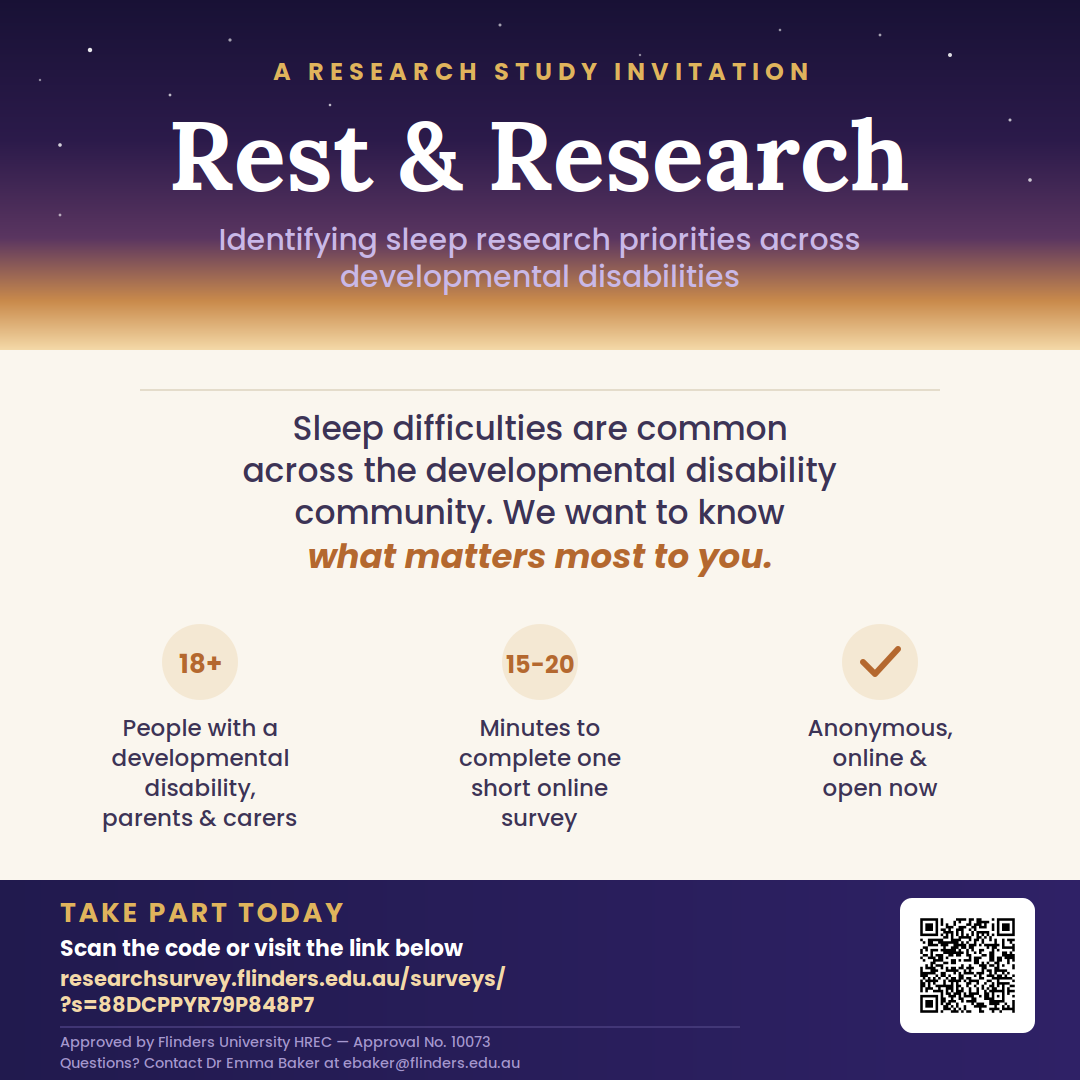
For many families in the Fragile X community, a good night’s sleep can feel out of reach. Sleep difficulties are common among people with Fragile X and other developmental disabilities, and often have broader impacts on mood, learning, behaviour, and daily life for the whole family. Parents and carers, too, often feel the effects of broken sleep leading to fatigue and exhaustion. Despite how widespread these challenges are, sleep research in our community still has a long way to go, and researchers don’t always know what matters most to people with lived experience.
That’s where Rest & Research comes in. Led by Dr Emma Baker at Flinders University, this study wants to hear directly from people with a developmental disability (including Fragile X, Autism, ADHD, and other genetic or intellectual disabilities), as well as their parents, carers, and family members of individuals. The survey asks about your experiences with sleep, how it’s assessed, and most importantly, what you think future research should focus on. Your answers will help shape research priorities so that future studies address the things that genuinely make a difference to you and your family, not just what researchers assume matters.
The survey is completely anonymous, takes about 15–20 minutes, and can be done in your own time, wherever suits you. You’re free to skip any question, and you can stop at any point. Respondents need to be 18 or older to take part, but you’re welcome to complete the survey on behalf of a younger child or family member, sharing their experiences alongside your own.
If this sounds like something you’d like to contribute to, Dr Emma Baker and team warmly invite you to take part. Every voice helps build a fuller picture of what sleep research and support should look like.
The survey QR code is above, and the direct link is below. If you have any questions, Dr Emma Baker is happy to help at ebaker@flinders.edu.au.
Take part: https://researchsurvey.flinders.edu.au/surveys/?s=88DCPPYR79P848P7
Approved by the Flinders University Human Research Ethics Committee (Approval No. 10073)
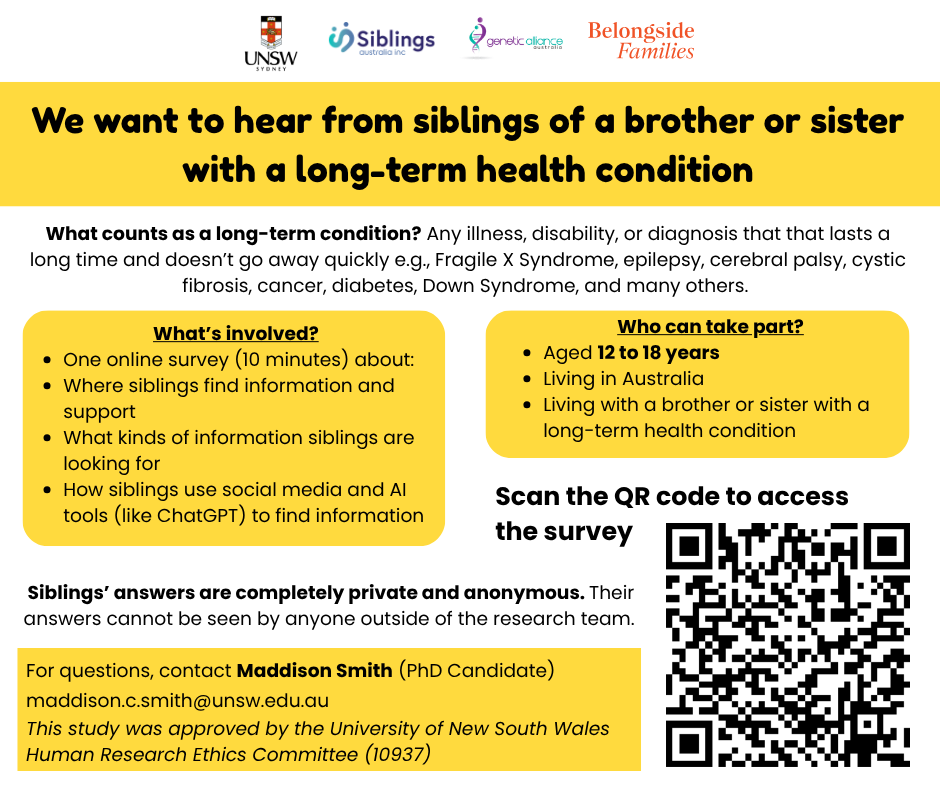
Growing up alongside a brother or sister with a long-term condition such as Fragile X syndrome often builds siblings’ empathy, resilience, and a deep sense of care for their family. But it can also raise big questions and emotions that they don’t always have support to work through. When reliable information and support isn’t easy to find, siblings may turn to social media or AI tools for answers and not everything they find there is accurate or helpful.
Right now, there isn’t enough research on how siblings in Australia find information and access support, which makes it hard to know what kind of resources would help. A research team at UNSW want to change that. By understanding where siblings look for information, they can build more resources designed around siblings’ real experiences.
This research is led by Maddison Smith (PhD Candidate) at the University of New South Wales, in collaboration with Siblings Australia, Genetic Alliance Australia and Belongside Families.
- What’s involved: An online, anonymous questionnaire that takes around 10 minutes, asking about where siblings look for information and how they use social media and AI tools.
- Who can take part: Siblings aged 12–18 years, living anywhere in Australia, currently living with a brother or sister who has a long-term illness, disability, or health condition (such as Fragile X Syndrome).
Siblings can go in the draw to win one of two $50 gift cards after completing the questionnaire. Their responses are completely anonymous and only used for this research project – even if they enter the draw, their name is never linked to their answers. If you or your child have any questions or concerns about privacy, please don’t hesitate to reach out to Maddison.
If you have a child who’s eligible, we’d love for them to take part. Please also pass this on to anyone who might be interested. If you have any questions, Maddison Smith is happy to help at maddison.c.smith@unsw.edu.au.
Siblings can take part here: https://unsw.au1.qualtrics.com/jfe/form/SV_cSErpUbE0BSGBj8
Approved by the University of New South Wales Human Research Ethics Committee (iRECS10937)
BUILDING KNOWLEDGE ON THE FRAGILE X PREMUTATION
The online International Fragile X Premutation Registry has been created to encourage research on the Fragile X premutation and ultimately lead to better care, and possible treatments, for females and males whose health is impacted by the premutation. The goal is to build knowledge about the Fragile X premutation. The Registry is a contact list stored in a secure online database.
The Registry was created by clinicians, researchers, family representatives and groups from around the world who partnered with the National Fragile X Foundation (US) and the UC Davis MIND Institute in California. The Registry team is led by Dr David Hessl of the UC Davis Mind Institute, and National Fragile X Foundation (US) representatives Robert Miller and Hilary Rosselot Fragile X Association of Australia is pleased to be a foundation partner in this important initiative, with our Board member Karen Lipworth part of the Registry team.
Who is invited to join the Registry? Female and male Fragile X premutation carriers from all around the world, and who are 18 years or over, are invited to join the Registry by enrolling online.
What’s involved? People who join the registry complete a survey to provide their contact, demographic, and basic medical details related to the Fragile X premutation. The data is stored in a secure online database.
As a participant, you will receive annual updates about research developments in this field, and you may also be contacted by the IFXPM Registry team about research studies you may be eligible to participate in, including future treatment studies. Researchers from all around the world, including Australia, will have the opportunity to submit details of their Fragile X premutation study to the IFXPR Advisory Committee for review. Where a study is approved for distribution, the IFXPR team will email a recruitment flyer to eligible participants.
How will the Registry help the Fragile X community? A registry that includes a large and diverse group of individuals with the Fragile X premutation, as well as family members without the premutation, will greatly facilitate research, including future treatment and intervention studies. Note that research is not restricted to medications, and includes any interventions that could positively impact quality of life. Participants may leave the Registry at any time should they no longer wish to be contacted about Fragile X premutation research participation opportunities and developments.
More information about the Registry, including Frequently Asked Questions and bios of the Registry Team, is on the National Fragile X Foundation website.
How to join the Registry? Enrolment in the Registry is done online, and it should take around 30 minutes to answer the enrolment survey questions.